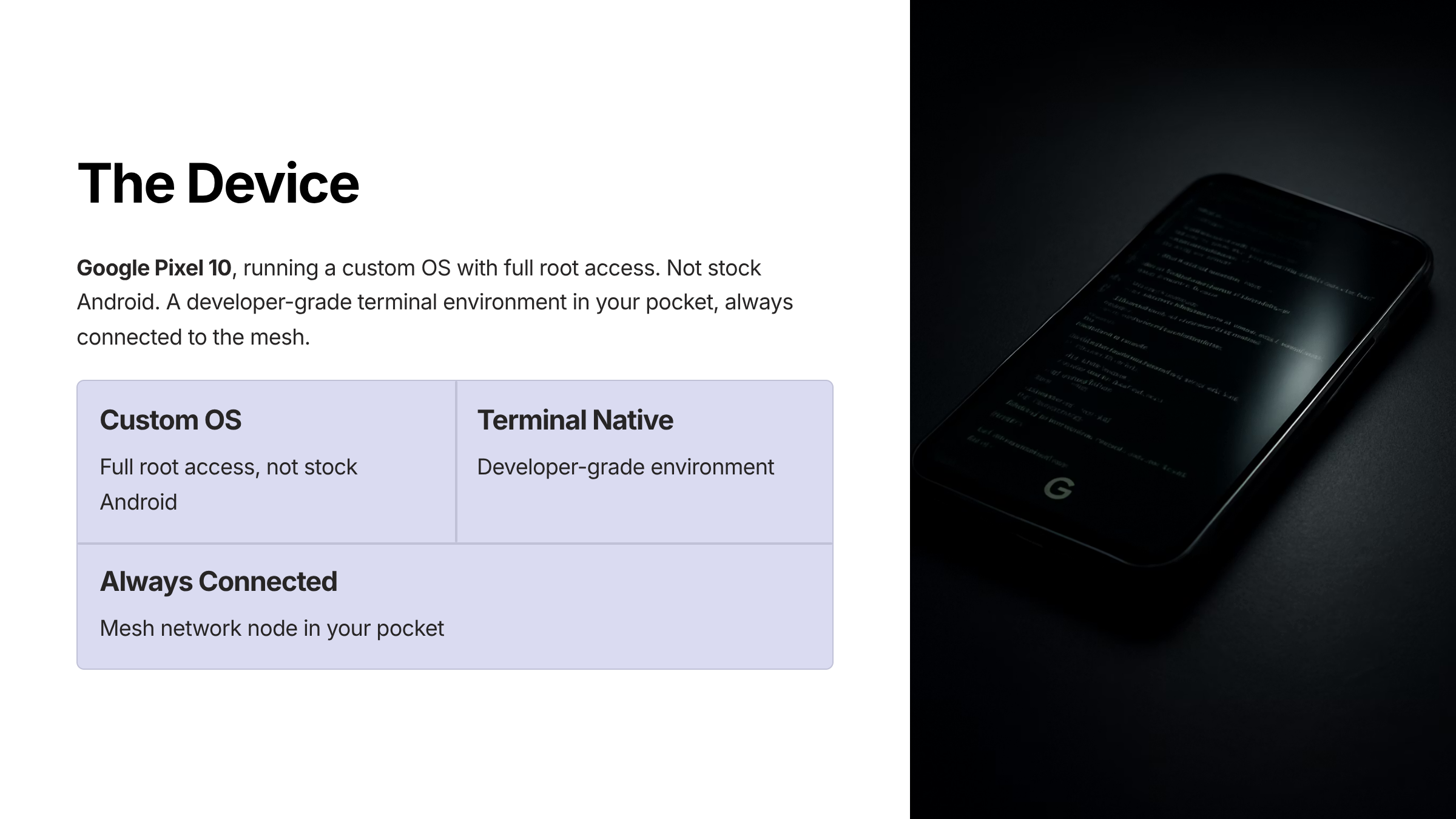
The phone is not a consumption device. That's the premise. Everything that follows is what happens when you take it seriously.
The Setup
Google Pixel 10. Stock Android is comfortable, polished, and locked down. We swapped it — installed an alternative OS built for privacy, control, and open access. Non-specific for obvious reasons. The result is a stock-clean Android surface with unlocked bootloader, full root via Magisk, and no carrier or OEM restrictions on what you can run.
This matters because once you have root, the phone is not a phone. It is a Linux node.
Termux: The Bridge
Termux is a terminal emulator and Linux environment for Android that doesn't require root to use — but becomes significantly more capable when you have it. With root and Termux, you get:
- A full package manager — apt-style installs for git, Python, Node.js, curl, ssh, and hundreds more
- Persistent storage access — read and write anywhere on the filesystem
- Background process execution — services that keep running when the screen is off
- SSH client and server — connect to any machine on the network, or make the phone itself reachable
We installed Node.js. We installed Claude Code. We opened a Claude session from the phone and made a code change to a live deployment — committed, pushed, Railway picked it up. From a phone. In a pocket. At root level.
What This Enables
The obvious use case is emergency access — you're away from your desk, something breaks, you need to push a fix. But the deeper use case is that the mesh doesn't require a specific machine anymore.
Our setup: three machines (Windows desktop, two Linux ThinkPads) connected via Tailscale. The phone is a fourth node. SSH from Termux into any machine. Run Claude Code remotely. Push changes. Check Railway logs. Fire MCP tool calls. The Patriot Squad MCP service is accessible from the phone just like from any other node on the mesh.
The phone becomes an access terminal for the entire lab infrastructure.
The Presentation Layer
What made this concrete was preparing a starOS Labs overview deck from the phone — using the Gamma API to generate structured slides from a content brief, then reviewing and editing the output via Claude Code. No laptop. The workflow we use to build the company's public-facing materials ran entirely on a Pixel 10 with a custom OS and a Termux terminal.
That's not a proof of concept. That's a production workflow.
What Root Actually Changes
Without root:
- Termux runs in a sandboxed user environment
- No access to system files
- Can't run services that bind privileged ports
- Storage access is limited to the Termux home directory
With root:
- Full filesystem access
- systemd-style process management via Termux:Boot
- Any port, any directory
- The phone behaves like a headless Linux server you happen to be able to hold
The custom OS layer adds another dimension: no Google Play Services tracking, no OEM-mandated bloat, a hardened network stack. The phone sends less and exposes less while doing more.
The Point
Every serious builder should understand what their devices can actually do when unlocked. The Pixel 10 on a custom OS with Termux and root is not a hacker novelty — it is a capable compute node running a familiar Linux environment. When it's connected to a Tailscale mesh and running Claude Code, it's a full participant in a multi-machine AI lab.
Carry the lab. That's the point.